

Trade shows are noisy. Not just literally, either. Everyone is shouting with visuals, giveaways, screens, and rehearsed pitches. So when you hand someone a business card, you’re not “sharing contact info.” You’re fighting for a memory slot.
Metal business cards win that fight more often than paper.
Hot take: most trade-show swag is junk
If your takeaway ends up in the hotel trash or the bottom of a tote bag, it didn’t “build brand awareness.” It became landfill.
A metal card from Metal Kards, on the other hand, tends to get kept. People set it on their desk. They show it to a coworker. They run their thumb along the edge while they’re half-listening to the next booth’s pitch. That’s not magic. That’s psychology and materials doing their job.
One-line truth: weight changes perceived value.
The booth moment: attention is a physical thing
Here’s the thing: at a trade show, you’re not competing against your category. You’re competing against fatigue. Attendees are scanning faces, logos, banners, snacks, badge scanners, everything, at high speed. A metal card interrupts that autopilot because it feels different in the hand.
Paper is expected. Plastic is… fine. Metal is a small shock.
In my experience, the best-performing booths don’t just “look premium.” They hand you premium in the first 30 seconds. Metal cards do that without needing a speech.
Brand signals metal cards send (before you say a word)
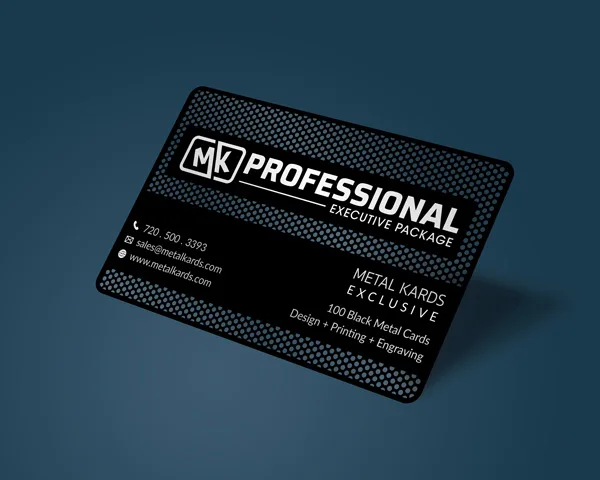
The material carries a message. And yes, people read it instantly.
Metal business cards typically signal:
– Credibility (you’re not operating out of a spare bedroom)
– Permanence (you plan to be around next year, too)
– Precision (if the card is engineered, the business might be)
– Confidence (you’re not afraid of standing out)
Now, this won’t apply to everyone, but if your brand is positioned as “affordable and friendly,” a heavy black stainless-steel slab can clash. A card can be too premium for its own good. The point is alignment.
Design: don’t get cute, get coherent
Some teams treat metal cards like a tiny billboard and cram everything on it. That’s a miss. Metal rewards restraint.
Go minimal. Let the material do some of the talking.
A few design cues that consistently work:
Finish choices
– Brushed metal reads modern and industrial.
– Matte reads discreet, high-end, “private banking energy.”
– Polished can scream luxury, but it also shows fingerprints (annoying at events).
Typography
Keep it legible. The moment someone squints, you’ve lost momentum. I’d cap it at two fonts, and honestly, one is often enough.
Edges and cuts
Soft chamfers feel expensive. Sharp corners can feel aggressive. Die-cut details are memorable, but they should connect to something real (a product silhouette, a logo geometry), not just “because we can.”
Durability isn’t a feature. It’s a follow-up strategy.
Trade show floors are brutal. Cards get stuffed in pockets, spilled on, dragged across tabletops, bent under lanyards, and tossed into bags with chargers and keys.
Metal doesn’t care.
That matters more than people admit, because the card you give out at 2:00 PM needs to still look good at 9:00 AM the next morning when the prospect is sorting their haul and deciding who to contact. Paper often shows up looking tired. Metal still looks like you meant it.
The tactile edge (yes, it’s real)
People think they’re rational at events. They’re not. They’re running on patterns and quick judgments.
A heavier object is routinely perceived as more valuable and more “serious.” There’s academic backing for that: a classic set of experiments found that heavier clipboards led participants to rate issues as more important and candidates as more serious (Ackerman, Nocera & Bargh, 2010, Science: “Incidental Haptic Sensations Influence Social Judgments and Decisions”). That’s not specifically about business cards, but the principle transfers cleanly.
So when someone feels your card has heft, their brain quietly upgrades the importance of the interaction. No one says this out loud. They just behave differently afterward.
Paperless sharing: metal doesn’t have to be analog
A metal card can be a physical object and a digital shortcut. That’s the sweet spot at modern events.
Options that actually work on a busy show floor
– QR code to a vCard landing page (fast, universal)
– NFC tap to open a contact card, calendar link, demo page, or product configurator
– Short URL as a fallback (because Wi‑Fi and phone cameras fail at the worst times)
Look, NFC is slick when it works. But I always recommend redundancy: NFC + QR together. People have different phones, different settings, different patience levels.
And don’t overbuild the destination. If the tap opens a heavy microsite that takes six seconds to load, your “premium experience” turns into a small frustration.
Budget vs impact: the math is not as simple as unit cost
Metal cards cost more per piece. Obviously. But per useful impression, they can be cheaper.
If a paper card gets thrown away in 24 hours, it produced maybe one impression: the handoff. If a metal card lives on a desk for six months, gets shown to a colleague, and triggers one “hey, remember this company?” moment, you’re suddenly playing a different game.
I like thinking in terms of:
– Cost per kept card, not cost per printed card
– Cost per qualified follow-up, not cost per handout
If your team hands out 500 paper cards to get 8 good leads, and 150 metal cards to get 12 good leads, the metal “cost” starts to look a lot more disciplined.
Industries where metal cards pull extra weight
Not every market responds the same way. Metal business cards tend to outperform in spaces where trust and perceived quality are part of the buying decision.
– Finance, wealth, professional services: trust signaling
– Manufacturing, engineering, construction tech: material honesty (it matches the product world)
– Healthcare, biotech, med devices: precision vibe
– Architecture, design, luxury goods: aesthetic authority
– Cybersecurity and enterprise tech: seriousness + modernity when paired with NFC/QR
If you sell something purely transactional and price-driven, metal can feel like overkill (or worse, like you’re compensating).
Make it part of the booth system, not a random flex
The best deployments I’ve seen treat the metal card as one node in a bigger experience: booth demo → quick conversation → tap/scan → personalized follow-up path.
Technical briefing mode for a second: if you’re doing this properly, you’ll map the card interactions to your funnel.
Trackable components can include:
– Unique QR parameters by event or rep
– Landing pages tied to product lines
– CRM capture with consent (don’t get creepy about it)
– “Book a meeting” links that drop straight into the right calendar
If the card is premium but the follow-up is generic, you’ve built a beautiful front door to an empty house.
Do metal cards drive more leads?
Sometimes. But the better question is: do they drive better leads faster?
Measure:
– Scan/tap rate (card interaction)
– Time-to-first-follow-up response
– Meeting set rate after the show
– Opportunity creation rate by rep and by event
– Sales cycle length compared to your baseline
In other words, don’t judge the card by compliments at the booth. Judge it by pipeline movement.
Because a metal business card isn’t just a nicer card.
It’s a tiny piece of leverage in a crowded room.